Are there still steamboats on the Mississippi?
Yes. Two true steam sternwheelers still work the Mississippi and the Steamboat NATCHEZ is one of them. What makes her real, and what the other boats run on.
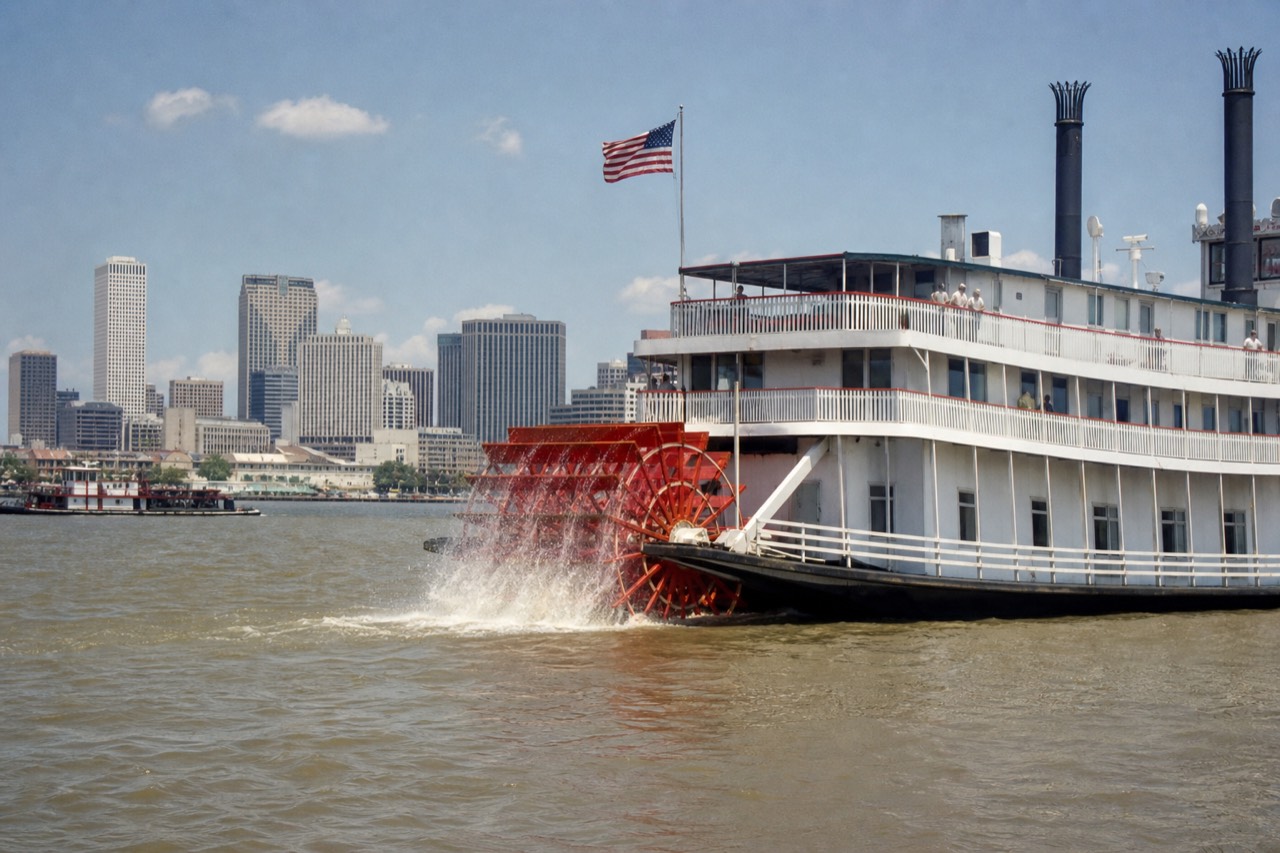
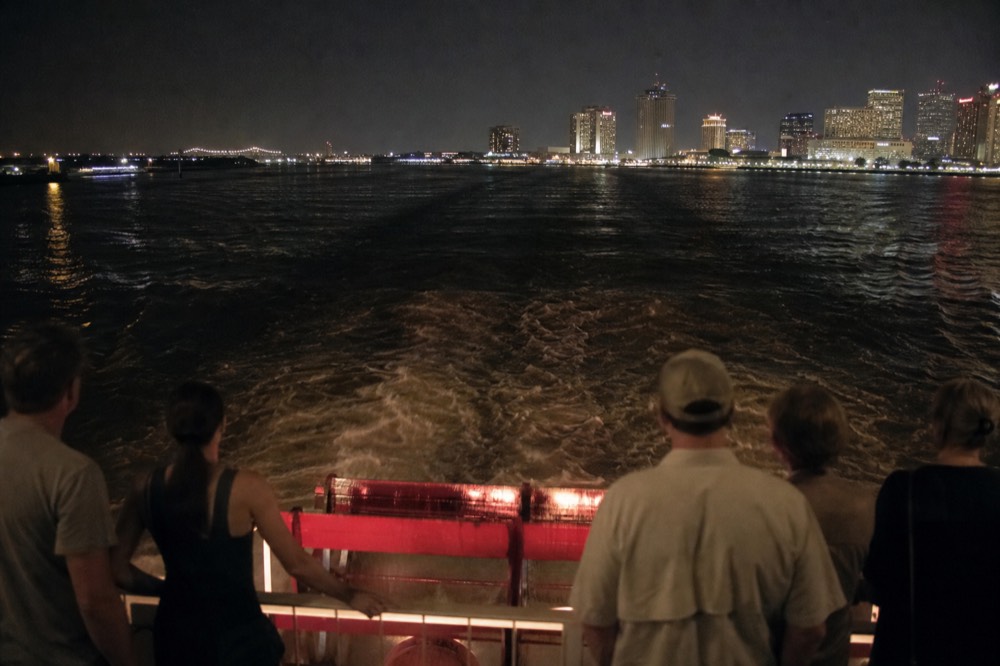
Stand at the stern rail as the NATCHEZ backs off the Toulouse Street Wharf and the deck moves under you in a way a diesel boat never moves. There is a slow shudder, then a rhythm, then twenty-five tons of white oak starts throwing water. I send first-time passengers to that rail for the first ten minutes of every sailing, because the difference between a steamboat and a boat with a wheel bolted on the back is something you feel through your shoes before you understand it with your head. Whether the old boat is still sailing today is its own question, and the answer is a firm yes.
So the short answer to the question people keep typing into search engines is yes. Steam did not vanish from the Mississippi. It got rare, and most of what floats past New Orleans with a paddlewheel on the stern is not steam-powered at all. Sorting out which is which takes about four minutes, and it changes what you book.
How many true steamboats are left on the Mississippi?
Two. The New Orleans Steamboat Company's own history states that when the NATCHEZ launched in 1975 she became one of only two true steam-powered sternwheelers plying the Mississippi, and that remains the count. Everything else with a paddlewheel on this stretch of river turns it with diesel-electric power.
That is a striking number for a river whose entire identity was built on steam. The first steamboat on these waters, the NEW ORLEANS, launched in 1811, and for the next century the packets and excursion boats set the clock for every town on the bank. The retired Captain Clarke "Doc" Hawley put it well on the company's own history page: standing on deck with the big wheel turning, you can look across the water and back to the days when time was measured by the coming and going of packets.
The fleet that disappeared did not all disappear at once, and you can trace part of the loss through one company's roster. Along with the NATCHEZ, the New Orleans Steamboat Company has also run the COTTON BLOSSOM, the JOHN JAMES AUDUBON, the PRESIDENT, the COMMODORE, the BECKY THATCHER and the AUDUBON EXPRESS on this river. The PRESIDENT was in its day one of the premier entertainment venues in the city, with the Rolling Stones, Tina Turner and Joan Jett playing aboard. None of those names carries excursion passengers here now.
What survives, survives because somebody chose to keep a nineteenth-century propulsion system running in the twenty-first. That choice costs money every year, and it is the whole reason this question has an interesting answer. Her current schedule is confirmed in the still-running answer.
What makes the NATCHEZ a working steamboat rather than a replica?
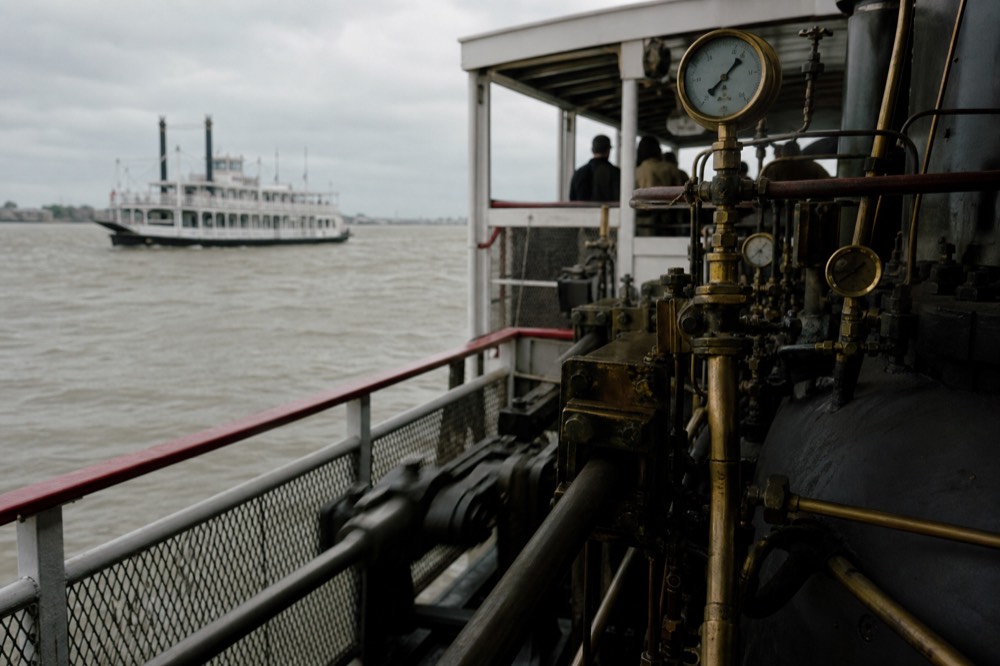
Her machinery is genuinely old and genuinely working. The steam engines driving her paddlewheel were built in 1925 for U.S. Steel Corporation's sternwheeler CLAIRTON. Her copper bell was smelted from 250 silver dollars for a purer tone and once hung on the S.S. J.D. AYRES. Her 32-note steam calliope was custom crafted in the Gilded Age style.
Plenty of tourist boats look the part. Gingerbread trim, a red wheel, a whistle on the stack. The NATCHEZ is the rarer case where the parts under the paint do the work. She was launched in 1975 at Bergeron Shipyards, built to modern safety and comfort standards but laid out to resemble the old sternwheelers VIRGINIA and HUDSON, and fitted with hardware salvaged from working river history rather than cast for the occasion.
She is the ninth steamer to carry the name. Her predecessor, NATCHEZ VI, raced the ROBERT E. LEE in the most famous steamboat race ever run, and the current boat has never been beaten in a race herself. The most recent one was on Valentine's Day 2003 against the American Queen, a charity match with proceeds going toward the renovation of St. Louis Cathedral. No date is set for the next.
The details that make her feel authentic are small and physical. The captain still barks orders through a hand-held megaphone. The calliope trills out over the wharf before departure, loud enough to hear from Decatur Street, which is how a good number of passengers find the boat in the first place. If you want the full account of her hardware and her nine namesakes, the boat's own guide goes deeper than this page can.
| Component | Detail | Where it came from |
|---|---|---|
| Steam engines | Built 1925 | U.S. Steel Corporation's sternwheeler CLAIRTON |
| Paddlewheel | 25 tons of white oak | Built for the boat |
| Copper bell | Smelted from 250 silver dollars for a purer tone | Once aboard the S.S. J.D. AYRES |
| Steam whistle | Copper and steel, a treasured antique | Salvaged river hardware |
| Calliope | 32 notes, custom crafted | Modelled on Gilded Age music makers |
| Hull | 265 feet, launched 1975 | Bergeron Shipyards |
Are the Creole Queen and the CITY of NEW ORLEANS steamboats too?
No, and neither operator claims they are. The Paddlewheeler Creole Queen made her maiden voyage in October 1983 out of Moss Point, Mississippi, and runs diesel-electric with a 24-foot paddlewheel. The Riverboat CITY of NEW ORLEANS was built in 1991, christened here in 2025, and is also diesel-electric with a working wheel.
This is the honest distinction most pages skip. A paddlewheeler is any boat driven by a wheel. A steamboat is a boat that makes that wheel turn with steam. Both of the other New Orleans excursion boats are paddlewheelers, both are handsome, and neither runs on steam.
The reasoning behind the newest boat is a matter of record rather than speculation. Matt Dow, who oversaw the project, has said the CITY of NEW ORLEANS runs a modern diesel-electric system because steam engines would have taken up too much room, and that the boat was designed for passengers who now want more time inside being entertained. She carries about 1,000 guests across four decks with roughly twice the dining capacity of the NATCHEZ, up to 600 for a sit-down dinner, plus elevators, a bar on every deck and a calliope of her own. She was christened on July 12, 2025 at the Bienville Street Wharf by Godmother Edna James. If that trade of steam for space appeals to you, the newest riverboat in the city covers what she gained.
The Creole Queen made the same choice forty years earlier. New Orleans Paddlewheels puts her at 880 passengers with the largest indoor dining capacity of any excursion boat in the city across three private dining rooms, and sails from Spanish Plaza rather than the French Quarter wharves. Her draw is history ashore rather than machinery below decks, which is a fair trade at her fares.
| Steamboat NATCHEZ | Riverboat CITY of NEW ORLEANS | Paddlewheeler Creole Queen | |
|---|---|---|---|
| Propulsion | Steam, engines built 1925 | Diesel-electric | Diesel-electric |
| Launched | 1975 | Built 1991, christened here 2025 | Maiden voyage October 1983 |
| Paddlewheel | 25 tons, white oak | Working wheel | 24-foot diameter |
| Calliope | 32-note steam calliope | Carries her own | Not published |
| Size | 265 feet | About 1,000 guests, four decks | 880 passengers |
| Dock | 400 Toulouse St | 101 St Louis St | Spanish Plaza, 1 Poydras St |
Can you actually see the steam engines while you sail?
Yes, and it is included rather than sold as an extra. The NATCHEZ carries a public engine-room viewing area that every ticket covers, from the $43.50 daytime sightseeing fare upward. You look straight at the 1925 machinery while it is running, which is the single best reason to choose this boat over the other two.
Most passengers walk past it. They board, find a table, order a drink and stay put, and the engine room sits open below them for two hours. Go down. The heat and the noise are the point, and nothing stands between you and the pistons.
The daytime sailing suits the machinery-minded better than the evening one, and not only because of the light. Duke Heitger and the Steamboat Stompers play the afternoon runs with a lighter touch than the Grammy-nominated Dukes of Dixieland bring at night, so it is easier to wander, look and come back. If you want to see the wheel and the engines in daylight, you can check the daytime departures and current fares and pick a date, or look at the same sailing on its second listing if the first one is sold out for your day.
There is one caveat that steam enthusiasts should read carefully. The operator reserves the right to substitute the NATCHEZ and the CITY of NEW ORLEANS for one another at any time, for any reason, and no refund is issued for a vessel substitution. If steam is your entire reason for booking, that risk is printed in the ticket terms.
Which sailing gets you closest to the steam?
The two-hour daytime jazz cruise, at $43.50 without lunch. It sails at 2:30pm after an 11:00am or 2:00pm boarding call, gives you daylight on the wheel, an open engine room and a lighter band, and costs less than half the evening dinner fare. The 75-minute run is cheaper still but leaves less time to wander.
Rank the options by how much time you get with the machinery rather than by price and the order changes. The short sightseeing run at $25.75 is excellent value and genuinely fun, but seventy-five minutes disappears fast once you have found a seat. The evening cruise puts you on the water at 7pm, when the engine room is still open but the boat is dark, busy and pointed at dinner and the Dukes of Dixieland. It is a better night out and a worse engineering tour.
The daytime sailing is the compromise that actually works. Two hours, the wheel visible from the stern, the calliope playing before you board, and enough room to spend twenty minutes below decks without missing anything. Adding the lunch buffet takes it from $43.50 to $65, which is a fair price for a meal but not the reason to be there. If you are weighing the boats against each other rather than the times, the head-to-head comparison of the NATCHEZ and the Creole Queen covers the ground this page does not, and the rest of the daytime sailings sit alongside it.
One last thing worth saying plainly. Steam on this river is now a preserved thing rather than a working economy, kept alive by one company on one boat with 1925 engines and a bell made from silver dollars. That is a reasonable argument for choosing her over the newer, larger, more comfortable option next door. It is also a reasonable argument for going soon.